How Live Event Video Production Works and Why It’s More Complex Than It Looks
For most people who attend a live event, whether it’s a conference, concert, or corporate awards night, they leave the space without a second thought about the video side of things. The video looks polished, the camera switching is seamless, and the big screens in the front of the room show just what’s needed. It feels like a well-oiled machine. Yet in reality, it’s a complicated world behind the scenes, and it starts well before anyone walks into the venue.
What’s Really Happening Behind the Camera
The moment a production team decides to film a live event, a considerable amount of planning goes into what needs to be done. Just the physical placement of cameras requires significant premeditated thought. Where can equipment be placed where it’s not obstructing sightlines? How many cameras do we need for this room to get the story? Are we going to need audience reaction shots or just focus on the stage?
For events that involve broadcast video, the stakes go up considerably. Broadcast-quality production means working to a much tighter technical standard than standard event coverage, frame rates, color grading, audio specs, and signal quality all need to meet specific requirements depending on how the footage will eventually be distributed or aired. It’s a different discipline from simply capturing memories.
The Infrastructure Is More Complicated Than You Might Think
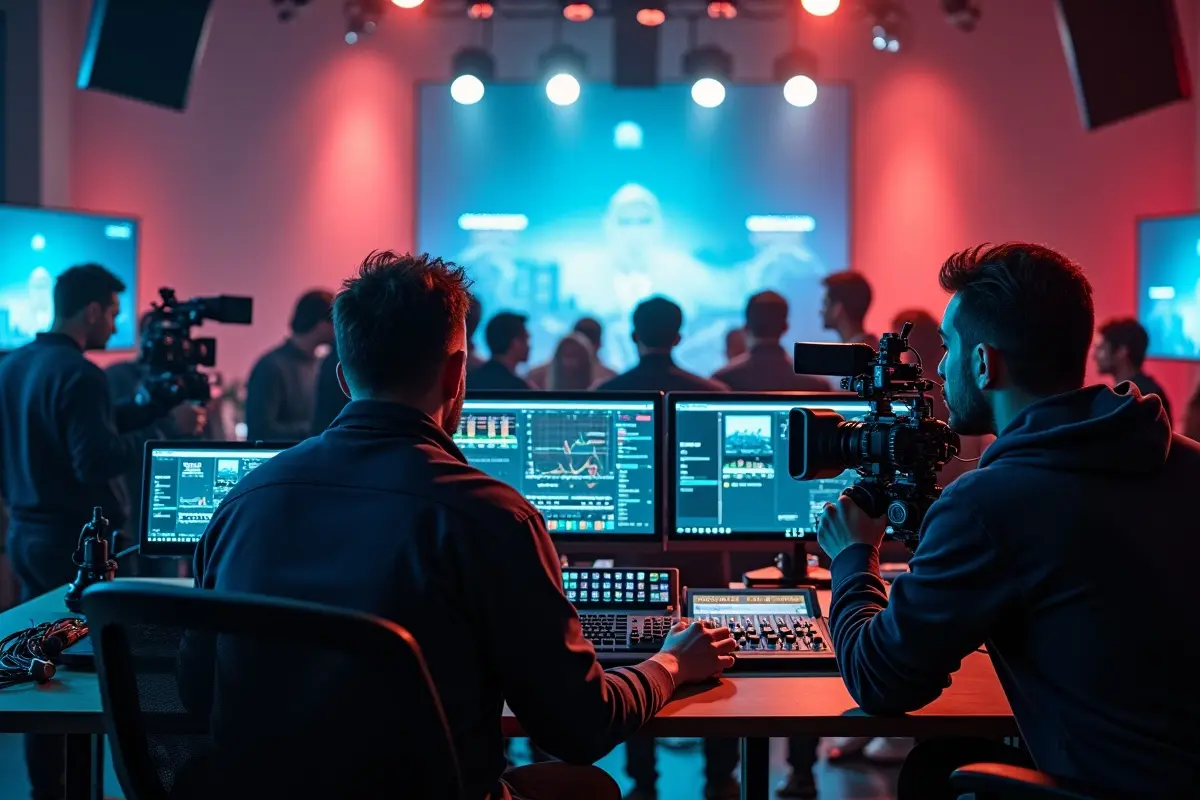
This is where things get tricky. A multi-camera live production all runs through a vision mixing system (effectively a control room that runs the pieces in real-time). The person at the helm has to keep pace with action on stage, switching from one camera to another as needed. If they lose timing, cuts feel out of place.
Audio is another animal altogether. Live events are unpredictable. A speaker turns their head and walks away from their microphones, background noise increases out of nowhere, a wireless microphone dies mid-sentence. An audio engineer needs to monitor each component as it happens, raising and lowering levels, killing noise, ensuring that what gets sent through to the camera feed (and the room) is clean and controlled. Few people think about this, but poor audio destroys good video quality more than almost any other single item.
Then there are the live graphics that go into this piece: lower thirds, titles, sponsor logos, countdown clocks, etc. These have to be created ahead of time, fired when appropriate, and folded in seamlessly to the video feed. For larger productions, a separate operator handles graphics so that the vision mixer can focus solely on camera work.
Success Is Determined Before Opening Night
It sounds like common sense, but right day of production is rarely when success is had or lost. It’s what happens during the weeks leading up to it. A well-planned production team will time the entire event, flagging moments that need angles shifted, where graphics need to come in, and spotting possible technical issues before they arise.
That’s why venue walkthroughs are essential. Lighting conditions, ceiling heights, power accessibility, and room acoustics all impact what’s possible later. A space that looks nice enough on paper as a performance space might have acoustic discrepancies that need adjustments before any mics are set. Planning accordingly keeps everyone on track when it matters most.
This kind of planning also dictates crew structure. Larger productions may need a director in the control room, independent camera operators, a dedicated audio team, graphics operator, and tech support in-house.
The Problem with Live Events? They Aren’t Forgiving – That’s What Makes Them Difficult.
What differentiates live events from any other kind of production is no going back for second takes. A speaker moves on to their next point. A performance happens once in a lifetime. If we missed our shot because a camera operator was shifting weight or didn’t convey interest in what they were doing? There’s no way to go back and fix it in post-production. Thus experience, preparation and collaboration are essential.
This is also why rehearsal time matters tremendously, even if it’s a limited tech rehearsal running through cues to ensure each element fires when needed can dramatically diminish something going awry during the live event day. Good production teams build in time for this as non-negotiable.
The Results Are Worth It
When live event production video works well, it multiplies an event’s reach beyond those in attendance. A corporate conference becomes something that can be shared globally with teams; a live event becomes something that’s archived long after everyone leaves the performance space for the day. It gets repurposed, archived, aired or distributed, but only with quality from the start.
That’s the benefit of knowing what’s involved. Events that don’t consider video until it’s an afterthought usually end up with footage that can’t do anything. Events that invest from the start get something overwhelmingly valuable, and something that represents just how high quality everything was initially created to be from the start.