
How to Create a Healthier and More Productive Physical Workspace for Your Team
A tidy office shouldn’t be considered an advantage, but rather a necessity. Just like you’d upgrade to high-speed internet or get better equipment, the overall hygiene in your workplace influences your employees’ productivity, health, and retention rates.
However, most companies don’t pay much attention to this. They see cleaning as a minor issue, an activity put on the back burner until circumstances are dire enough to merit it. This hasty solution is more expensive than most managers would assume. Nonetheless, making changes doesn’t mean you have to break the bank. It’s just a matter of altering your perspective on how the work environment affects your employees’ performance.
Absenteeism And Presenteeism: The Numbers Nobody Tracks
The costly impact of employee sickness is often underestimated. The first visible effect is a missed day. An absent team member adds strain to colleagues and can cause a cascade of slipping deadlines. Yet the larger cost likely comes from employees who tough it out at the office even while operating at a fraction of their capacity. People arrive at work sick because they think their presence is vital, because they’re afraid of being penalized for using sick days, or simply because they don’t realize their symptoms would probably have sent them home from a restaurant kitchen.
Employees who slog through a 9-to-5 while dragging from a viral infection, a sinus infection, hangover-like exhaustion from a low-intensity allergic reaction, or another contagious illness transmit their diseases to co-workers. They also collect more of their colleagues’ germs. Each contaminated doorknob or shared keyboard represents an opportunity for a sick employee to spread their diseases to surfaces for the next 24 to 48 hours.
Washing one’s hands generally isn’t enough; we’re constantly shedding viral particles from our respiratory tracts, and those are what commonly lead to colleagues’ illness.
What Clutter Does To The Brain
Business cleanliness has a psychological component that is not fully addressed in discussions about facilities. Visual mess – like piles of documents, untidy common spaces, bins that are full to the brim, and surfaces that are littered with multiple objects – leads to what cognitive scientists describe as cognitive load. The brain needs to filter out non-essential information, and this process consumes mental resources.
In other words, if employees are working in a cluttered, messy space, they are already feeling mentally exhausted even before starting their tasks. Their ability to engage in complex thinking, creative planning, and long-term concentration is diminished because their brainpower is used to process unnecessary distractions.
Keeping a clean desk daily is not a superficial preference. It is a necessity that enables the brain to start the workday fresh the next day.
Indoor Air Quality And Cognitive Performance
Most of the office performance discussions do not consider air quality. If there is poor ventilation, dust in the HVAC ducts, and unchecked filters, CO2 levels increase and airborne allergens spread. The results are not dramatic but fatigue, headaches and slower decision-making occur more frequently.
A research study from the World Green Building Council reports that organizational productivity goes up by 11% when employees work in an environment where they have access to fresh and clean air with optimal ventilation – a number that comes by reducing airborne pollutants. That is not an insignificant increase. An 11% increase in productivity in a twenty-man team equals the work output of two full-time employees.
The HEPA filtration in the HVAC system captures dust particles, microscopic allergens, and viral matter that standard filters usually miss. Proper cleaning of the ducts along with regular fresh air exchange is well within the realms of what you should be doing to improve how sharp your team is feeling by mid-afternoon. This is the usual time when you’re most exhausted and yet required to perform your best.
Sick Building Syndrome is a well-defined occupational health condition in which people consistently get sicker the longer that they remain in a particular building. The health symptoms they experience can directly be attributed to their time in that building. This is entirely avoidable. Yet, it is far more prevalent than employers care to admit.
Why Professional Cleaning Is A Business Decision, Not A Luxury
While it’s a good demonstration of community and that all-hands-on-deck attitude that any successful culture needs, research is increasingly clear that a cleaning schedule relying on employee goodwill alone is neither effective nor safe.
Internal cleaning schedules and employee chore rotations have their place, but they have a ceiling. An employee tidying their own desk is not the same as deep sanitization of the environment they work in. Partnering with a professional service like https://precimaxclean.com.au/ means the work is expertly managed, implemented, and scaled by the service provider according to need. And those needs are identified directly by the principles of the dynamic and modern cleaning industry they belong to – commercial, office, industrial, hospitality, health, maintenance, etc.
So while you don’t need to outsource your toilet scrubbing, enabling a professional partner to worry about the heavy-duty work ensures that you offer a safe and welcoming, high-performance space for the real stars of your business to feel motivated under your roof.
Mapping The Real Bacterial Hotspots
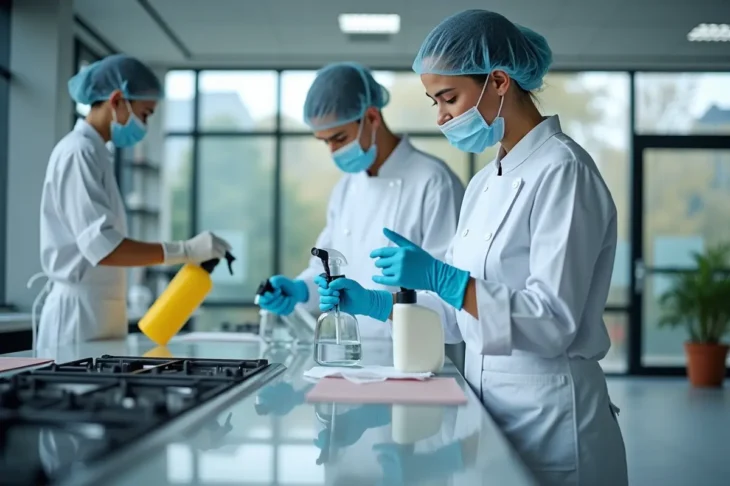
Typically, most office cleaning regimes only care about visible dirt – and what’s paid for. So that means floors, desktops, and bathroom floors. The germ hotspots that we’re interested in, the ones that really drive transmission, get overlooked. The refrigerator door handle is touched by every single person in the office at least twice a day and never cleaned. The office coffee machine is in a similar boat. All those people in a meeting room passing the phone around or using the office tablet? The edges of those monitors are gathering bacteria with every tap. None of which is exactly glamourous to clean, but it’s where all the cross contamination is happening.
Cross-contamination is particularly effective at spreading disease. If someone coughs over your workstation, you don’t tend to lick your desk. But people eat and drink in the kitchen or breakroom. They cough or sneeze into their hand then open the door. They’re way more likely to get something into their body. But still, we don’t prioritize cleaning there.
Sanitizing the high-touch points in an office environment, with a clear list of what those surfaces are, and how often and with what you clean them, is one of the highest-impact, lowest-cost steps that any business can take.
Building A Clean Desk Policy That People Actually Follow
A clean desk policy backfires if employees perceive it as an imposed rule, but it’s successful if they see it as a positive practice for a better shared workspace.
Here’s how to make it work. Clearly communicate that the expectation is that personal items and any work in progress are either stored or removed from surfaces at the end of each workday. Then ensure that every workplace has the necessary storage and equipment to make this easy. If we don’t have anywhere to put our things, we won’t put them away. If it takes five minutes to pack items away and another ten to retrieve them the next morning, we won’t bother.
Next, lead by example. It’s hard to demand that employees keep their desks clear while your office looks like a paper recycling warehouse exploded in it. Staff will notice that sort of hypocrisy and resent it. A good clear desk policy helps, in part, to model for employees what is expected, and that means keeping your workspace clear too.
Choosing Cleaning Products That Don’t Create New Problems
Harsh chemical cleaners do more harm than good. Chemicals like bleach, ammonia, and other powerful disinfectants create fumes that can be harmful to the operators who use them, not to mention the people who work in the building where they were used. Even hours after the cleaning was done, the residue from the chemical agents can remain and continue to be inhaled, causing many allergic reactions.
Commercial green cleaning products are made from low-VOC, biodegradable, non-toxic substances that reduce the impact on the health of cleaning employees and building occupants. Green cleaning products often come in recyclable packaging and are manufactured using processes that reduce pollution.
Waste Systems And The Behavioral Side Of Cleanliness
Where bins are located influences how individuals dispose of their waste. This may seem obvious, but the reality is office waste infrastructure is often planned based not on reducing mess, but on reducing the number of bins.
If the closest bin to someone’s workstation is 10m away, they will leave waste at their desk. If the recycling option is 20m away from where people actually produce recycling, it all goes into general waste. Or sits out. If composting bins are not in the space where organic waste is generated, employees won’t bother.
By locating waste, recycling, and organic waste points strategically around the office – particularly near high-use areas like the kitchen, printer stations, and communal tables – you eliminate the friction that leads to accumulation.
What A Clean Office Signals To Your Team
Human Resources departments are becoming increasingly aware of the impact business cleanliness has on employee retention. When your team arrives at work and finds a fresh, clean, well-kept office, it sends a clear message that their health and comfort are valued by the organization they work for.
Likewise, if your team is faced with dust, dirty bathrooms, bad smells, or stains in the carpet, they also receive a message. This message isn’t subtle and is interpreted as the organization’s attitude towards them and their well-being. These perceptions will begin to affect their level of engagement, their willingness to exert discretionary effort, and eventually, their decision on whether or not to stay with the organization.
A potential new hire who comes in for an interview and sees a poorly maintained office or workspace will form negative opinions of the organization before they even sit down to discuss the job at hand.
Essentially, your team’s workspace can only work for them or against them. If you prioritize business cleanliness and manage it well, it will be a solid operational improvement to your company. Implement the right habits, manage the quality of your air, sanitize important surfaces, and hire professionals when needed. The results will start showing in the form of missed sick days, productive afternoons, and employees who stay with you for the long haul.