
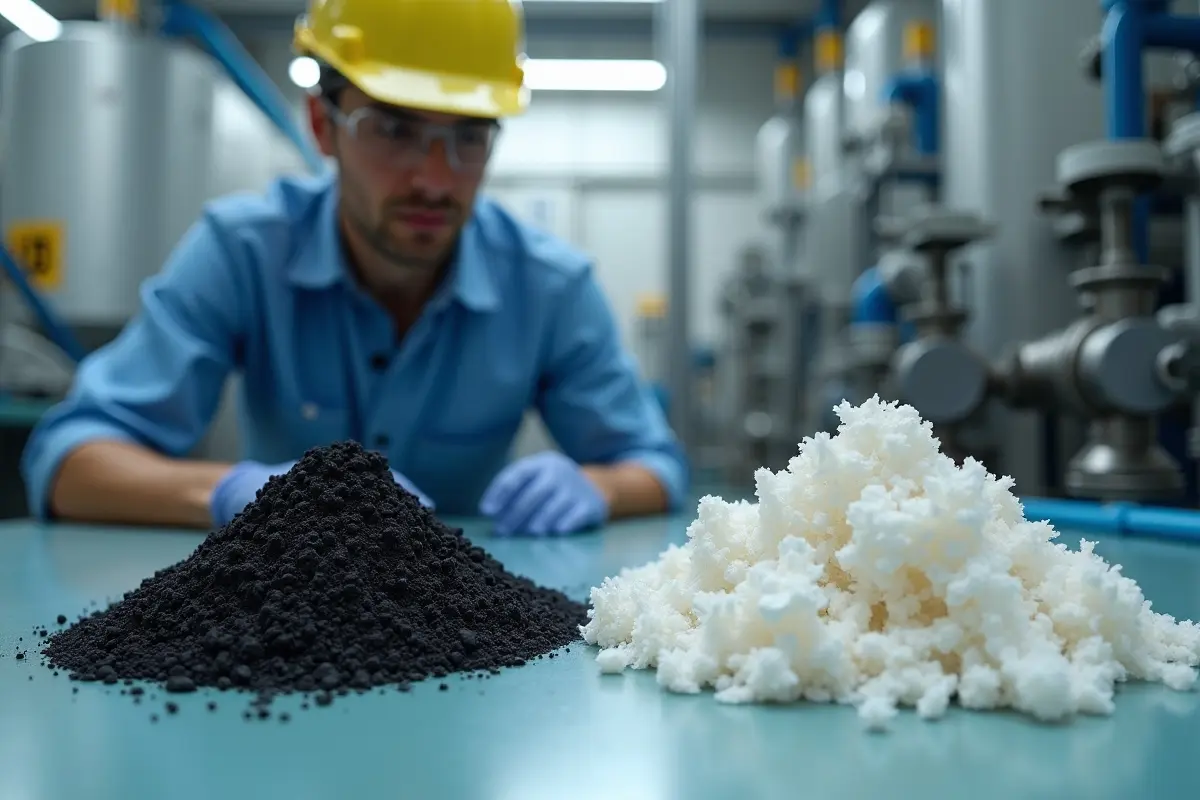
Activated Carbon vs Zeolite: Choosing the Right Media for Industrial Filtration Systems
In many industrial applications you might use one or the other, or both in series, for optimum effect against a specific spectrum of pollutants, even though it’s unusual to come across a single contaminant mix that calls for both. Adsorption of VOCs is specifically the realm of activated carbon, while zeolite is the only economical choice for effective ammonia removal.
Two different removal mechanisms, one filtration goal
Activated carbon functions by adsorption. This means that dissolved organic molecules, such as chlorine by-products, solvents, and taste and odor molecules physically adhere to the vast internal surface of the carbon particle. The carbon particle holds myriad micropores that are in contact with the adsorbing surfaces. The higher the surface area the grade of carbon has, the more mass of the contaminant it can hold before breakthrough.
Zeolite functions by ion exchange. The highly porous crystalline aluminosilicate structure of zeolite has a negative charge that attracts positively charged cations (lowest level subunits with a net positive charge). Ammonium, lead, zinc, copper, and cadmium cations can be exchanged for sodium, calcium, or potassium cations in the channels of the zeolite by an ion-for-ion exchange reaction. Zeolite has no surface onto which to adsorb. They simply exchange ion for ion until the exchange sites have been utilized.
This means far more than any comparison between spec sheets. A VOC plant will get virtually nothing out of zeolite. A recirculating aquaculture system battling ammonia buildup will get virtually nothing out of carbon. They’re not competitive products. They’re horses for courses, and the course dictates the horse.
Matching contaminants to the correct media
Let’s begin with what substances are present in the water. Chlorine, trihalomethanes, PFAS, and organic taste and odor problems fall under the domain of activated carbon. When it comes to producing drinking water, this is the go-to option. It has been used in municipal treatment facilities for many years.
If you have ammonia-rich wastewater, then zeolite is the solution for you. Whether it’s mining wastewater containing dissolved metals, municipal wastewater with high levels of ammonium, or an aquaculture facility with high ammonia concentrations due to fish waste, the exchange capacity of clinoptilolite can effectively serve as a sponge for ammonium. Zeolite hardly notices dissolved organic contaminants, and carbon is not particularly bothered about ionic impurities. There is no single catch-all solution.
The most common error we see is activated carbon being used on its own for a waste stream containing heavy metals or ammonia. The plant operators scratch their heads when they continue to violate their discharge limits, blaming the carbon as if it has failed to do its job. The reality is that it was never intended to.
What the physical properties tell you
Granular activated carbon is usually characterized by a specific surface area between 800 and 1,500 m²/g as measured by BET analysis, a number you’ll see referenced all over the place in water treatment literature and on manufacturer datasheets. That surface area, along with a distribution of micro, meso, and macropores, is what allows carbon to be adsorptive across such a wide spectrum of molecule sizes.
Compare this to zeolite, where that crystalline structure means it operates more like a molecular sieve than a sponge. It’s the cation exchange capacity, not the surface area, that engineers should be comparing when they’re shopping around. A higher CEC means more exchange sites available per unit volume. More exchange sites mean more capacity to trade out the ammonium or metal in your water before breakthrough.
But here’s the thing: that isn’t a one-for-one comparison of different metrics for the same property. Surface area tells you about how much the carbon can adsorb. CEC tells you how much the zeolite can exchange. If you’re comparing the surface area of the one to the CEC of the other, you’re comparing the wrong numbers, and there are better ways to sell this stuff than confusing potential clients with mismatched metrics.
Operational behavior: attrition, pressure drop, and backwashing
Zeolite is harder and denser than most activated carbon grades. That has real consequences on the floor. Denser media resists attrition better, which means fewer fines generated during backwashing and less media loss over time. Carbon, particularly lower-grade GAC, breaks down faster under repeated hydraulic stress, and those fines can cause channeling and increased pressure drop across the bed.
Pressure drop and hydraulic loading rates determine bed depth, grain size, and how much energy the system needs to push water through. A bed that compacts or clogs faster demands more frequent backwashing, which costs water, time, and labor. Because zeolite holds its structure better under repeated cycles, plants often see a longer interval between backwash events compared to a comparable carbon bed under similar loading.
None of this shows up on a datasheet in a way that’s easy to compare. It shows up in maintenance logs six months into operation, which is usually too late to change the original media selection without a costly retrofit.
Regeneration, lifespan, and disposal costs
This is also where the lifecycle economics part ways. Spent granular activated carbon typically has to be landfilled and is considered hazardous waste when it fails the TCLP test at 5 mg/L, or when a TCLP test has not been carried out, as is often the case. Many treatment plants, particularly small ones or those in remote locations, have little choice but to assume the worst and bring all spent carbon to the landfill. The regulatory environment has tightened dramatically in many states, making it increasingly difficult and costly to landfill spent carbon.
In contrast, most regenerated zeolite media can be beneficially repurposed as an agricultural soil amendment for pH control or nitrogen removal. This is because the metal contaminants adsorbed into the zeolite are ion exchanged for benign calcium, magnesium, or sodium ions that are already present in the soil in much higher concentrations and, in the case of nitrogen, removed by the nitrification process and released as natural gas. The exceptions to this are media that have been used for uranium site remediation or that have reached the end of their useful life due to factors other than chemical capacity, such as physical degradation of the media itself.
Sourcing quality media that actually performs
All zeolites are not created equal, which includes how suppliers grade it. Significantly, the grain size distribution, uniformity coefficient, and mineral purity all vary between deposits. This directly impacts the exchange capacity of the media and how it functions in a filtration bed. An extremely poorly graded batch with too many fines causes channeling and reduced contact time no matter how great the mineral.
For operators running a continuous industrial filtration process, sourcing the media can be as significant as the mineral itself: freight delays on a critical replacement, or simply not being able to find enough of the right material, can take your plant offline or force you into non-compliance. Operators evaluating zeolite Australia supply options reduce that freight lag by sourcing locally and get more consistent batch-to-batch product than through lengthy overseas supply chains. For media that needs periodic replacement or top-up, the benefits add up over the life of your system.
If you’re only thinking specs for your next tender, the fine print matters more than you want it to. And don’t believe the brochures – ask any supplier for their CEC testing methodology and grain size distribution data. A vendor who can’t produce it on request usually can’t guarantee the performance of the product batch to batch either. It also creates impossible contracts for commercial operators who furnish zeolite but have to guarantee an unproven final quantity of nitrogen removal or some other ion-exchange outcome.
Hybrid designs for complex industrial streams
The majority of industrial wastewater is not contaminated with a single substance. Wastewater from mining may contain both dissolved metals and residual chemicals. Wastewater from food treatment may contain ammonia and organic load. When this happens, using a single media is not the best solution. A sequenced bed design does this much better. Upstream, zeolite exchanges ammonium and heavy metals from the stream. Downstream, carbon adsorbs the organics that were not adsorbed by zeolite. This multimedia strategy is more expensive in terms of equipment and design, but the effluent quality is superior to what could be obtained by each media.
The sequencing of the beds is also important. If a stream with heavy metals is sent first to a bed of carbon, the capacity for organic removal is wasted on a contaminant class it can’t actually process, and the carbon doesn’t protect the zeolite downstream from anything either. It is recommended that the beds be arranged in such a way that the removal mechanism matches the contaminant.
A step-by-step framework for selecting media
Forget about the comparison chart. Instead, focus on the water.
First, get to know the raw water. Obtain as complete a chemistry as possible – including pH, temperature, and flow variation – on the contaminants you’re trying to remove. This will eliminate the vast majority of poor media matches that will cause the treatment system to underperform.
Second, establish the target. Before you specify any media, you have to know how clean the water has to be at the end. The delta between the raw water quality and your expected final treated quality tells you the level of removal you need.
Third, do the math on flow rate and contact time. This gives you the bed volume or the size of the vessel and determines whether you can realistically achieve treatment in a single vessel.
Fourth, create a short list for media selection by contaminant-mechanism match and then verify with bench-scale or jar testing using your water, not the vendor’s. Anytime someone bases a performance claim on “tested with representative samples and sure, we’ve got you covered,” run. It is crazy how often that representative sample is nothing like the water you’ve actually got.
Getting the mechanism right beats getting the brand right
Choosing the right filtration media depends on what you are trying to remove, not what a salesperson is trying to sell. Get the contaminant profile right, test with real water, and don’t be afraid to run zeolite and carbon in sequence when the stream demands it. The plants that get this right treat media selection as an engineering decision built on data, not a procurement decision built on habit.